

Personal Statement Advice
Where to start?
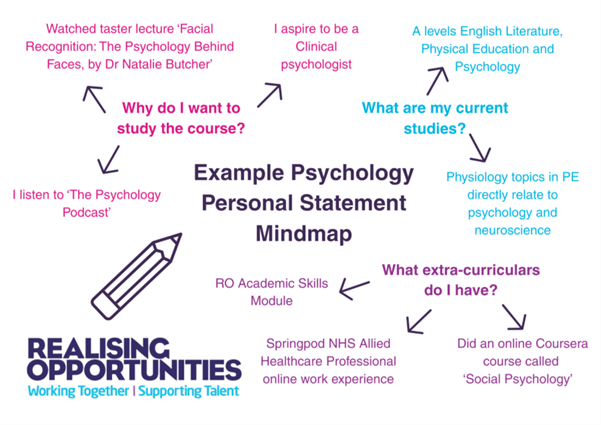
The new 2026 UCAS personal statement structure makes it a lot easier to start! I would suggest making a mind map with a bubble for each question. Brainstorm all of your commitments within these categories and then try to link all of these to the course that you are applying for.
*See my example for Psychology below!
What kind of things did I write about in my personal statement?
I spoke about some personal and professional reasons for studying psychology. My personal reasons included because I am a twin, so I was particularly curious about individual differences. My professional reason (which hasn’t changed even 4 years on!) was that at time of applying I was working in the NHS as a GP administrator and had come across the career of a clinical psychologist there; I was drawn to this profession because I wanted to help people in a mental health setting and because I found working in the NHS extremely rewarding.
In the educational section, I drew together my A levels: English Literature, Physical Education and Psychology. I said that English provided me with excellent critical analysis and writing proficiency. It complimented psychology well when describing and evaluating phenomena. I then explained that in Physical Education we had sports psychology topics and physiology topics that were supporting my understanding of how the whole body is relevant to psychology.
In my extra-curriculars I wrote about online work experience in a related healthcare field, some books about psychology that I had read and also some taster lectures that I attended! I was very specific about these and referenced the lecturers and the names of all the resources.
Where can you find things to discuss in your personal statement?
Coursera is the organisation that I did my online course through; there are a variety of courses relevant to any degree. I also completed online work experience through Springpod who host webinars and interactive days with professionals in different organisations ranging from the NHS to law firms. Both of these resources are free!
It is recommended that you also reference your participation in the Realising Opportunities programme! You will have attended some excellent taster lectures and learned academic skills. These will all be impressive activities that will prepare you for degree-level study and may have sparked your interest in your course further!
I hope you find some of this helpful!
Please remember that you can email me at RO.ambassador@newcastle.ac.uk with any questions or queries about university, the programme and your applications!
Imogen 😊