


Research Intensive Universities – What are they?
When students think about university, they often focus on rankings, location, or course titles but one factor that shapes your academic experience is whether your university is research-intensive. A research-intensive university is one that prioritises and invests heavily in conducting original research, so you are not just taught existing knowledge but new knowledge is created through studies and scholarly work 📚 What does this mean for you as a student?
Let me outline the benefits of research-intensive universities so that you can make the right decisions for you.
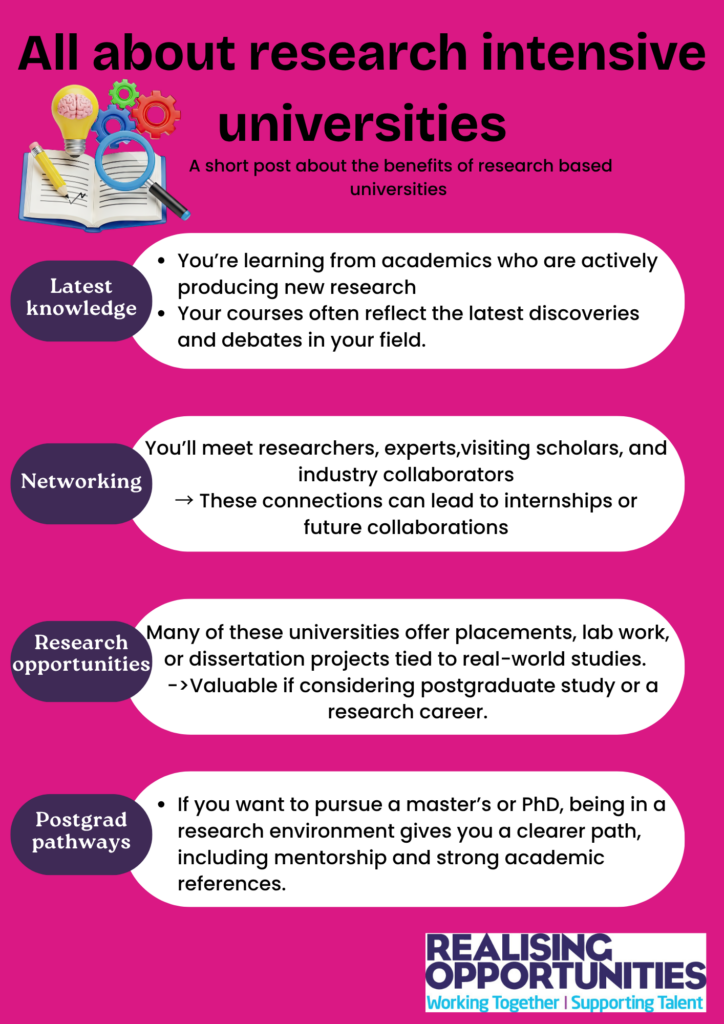
Cutting edge knowledge💡
At a research-intensive university, you’re not just learning what’s already in textbooks, you are often engaging with ideas that are still evolving. Lecturers frequently incorporate their own research into teaching, which means you’ll encounter cutting-edge theories, recent discoveries, and ongoing debates. This keeps your learning fresh and relevant to the current world, especially in fast-moving fields like science, technology, and economics.
Research experience
Research intensive universities provides more opportunities for students themselves to get involved in research. I would say one of the biggest advantages is the chance to get involved in real research. This could mean assisting in a lab, contributing to a research project, or completing a dissertation that explores unanswered questions. These experiences go beyond standard coursework and help you build practical skills like data analysis, academic writing, and problem-solving. These are all skills that are highly valued both in academics and in the work industry.
As a medical student, I have had the chance through placement to get involved in research around shoulder surgery and their risks. This massively helped me in refining my writing, using articles and navigating external sources and also writing references. We are hoping to present our research and publish it soon!
Facilities
Research requires resources, and these universities therefore usually have them. From advanced laboratories to extensive libraries the facilities tend to be above average. This is particularly beneficial if your subject involves experiments, technical equipment, or require in depth books/articles etc.
Networking 👥
Research universities collaborate with industries, experts and international scholars so you are likely to encounter a wide range of people. There are guest lectures, research partnerships, and academic events that create opportunities to build connections quite early on. These networks can then lead to internships or even future job opportunities. Meeting like-minded people who are interested in the same research can be exciting and encourage you to get more involved!
Post graduate pathways
If you’re considering a master’s degree or PhD, being in a research-intensive environment can make the transition smoother. You’ll already have access to experienced supervisors, exposure to academic research early on, and opportunities to build a strong academic profile. This can give you a clear advantage when applying for competitive postgraduate programmes.
Overall, research-intensive universities offer an environment that stimulates critical thinking, but they’re not automatically the best fit for everyone. Some students may thrive in smaller, more teaching-focused settings with closer support. It’s important to think about how you learn best and what you want from your university experience.
Choosing a university is more about finding the environment where you can grow, challenge yourself, and build the future you want.
I hope this has given you an idea of research intensive universities 😊
If you have any further questions feel free to get in touch at ro.ambassador@newcastle.ac.uk –I’d be happy to help
Varsika